Schools Are Closing. We Have the Data. So Why Are We Still Guessing?
America's schools are shrinking. But are we measuring what closing them actually saves and what children lose?

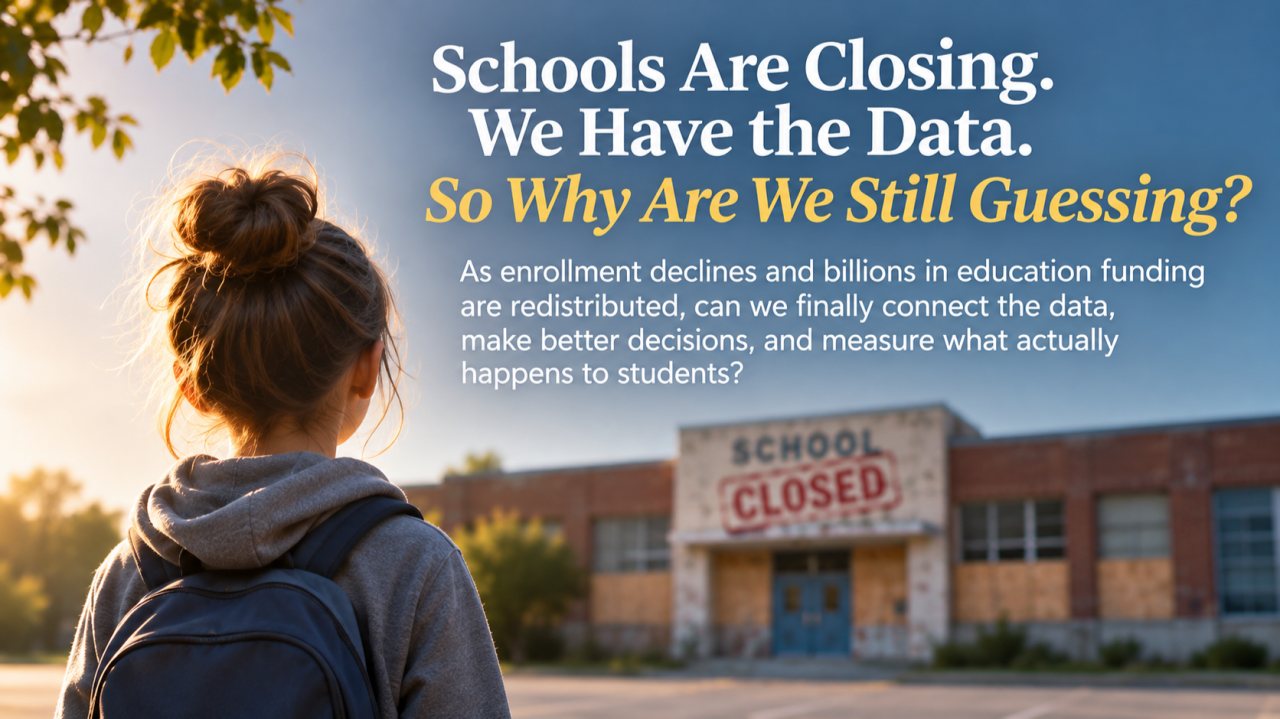
In 2007, Los Angeles Unified identified a group of school construction projects it no longer needed. One of them was built anyway.
Today, that $34 million campus near downtown Los Angeles has stood vacant since 2021. The district is spending at least $20,000 a month on security and maintenance, according to the Los Angeles Times.
A building once intended to educate children now consumes public money simply to remain empty.
That is more than a real estate problem. It raises a fundamental question about how we plan, what we measure, and who is accountable when the numbers change.
We knew fewer children were coming.
The Wall Street Journal recently reported that U.S. public school enrollment was approximately 48.8 million in 2025–26, down 3.7% from 2017–18.
Federal data show more than 1,000 public schools closed in 2025–26, up from 755 four years earlier.
Some of this decline is not mysterious. Children born during years of falling birth rates eventually reach kindergarten. Add migration, housing costs, changing family preferences, and the expiration of pandemic-era funding, and the pressure on school budgets becomes substantial.
But falling birth rates are not evidence of poor school leadership. Nor is every closure a mistake. A half-empty building still needs maintenance, staffing, and utilities. Maintaining too many under enrolled campuses can limit educational opportunities.
The real question is different:
If demographic decline was visible years in advance, why are so many communities confronting its consequences as an emergency?
Fewer students do not mean fewer needs.
New York City's comptroller reported in October that public schools lost nearly 22,000 K–12 students in 2025–26. Yet the number of students with disabilities has risen over the past decade. English-language services, transportation, and support for families experiencing housing instability remain essential.
Enrollment falls. Complexity doesn't necessarily fall with it.
That distinction matters when leaders promise savings from closing a school.
Students still need classrooms, qualified teachers, accessible services, and safe routes to a new campus.
And closures can carry costs that rarely fit neatly into the first slide of a board presentation.
A 2026 Stanford study examined California districts from 2011 to 2019 and found that closures did not, on average, meaningfully improve their overall financial position. Reductions in spending were accompanied by reductions in revenue.
Closing a building is not the same as fixing a budget.
The missing infrastructure is accountability.
School systems collect enrollment forecasts, facility costs, academic results, staffing data, transportation plans, and student-service records.
But can families see how those numbers fit together?
Before any school closes, a district should be able to explain where its enrollment forecast came from, what assumptions it made about births and migration, how those assumptions changed, and what alternatives would cost.
This is where data provenance becomes essential: the ability to trace information to its source, methods, and limitations.
It's not simply a technical requirement. It's a foundation for public trust.
Parents should also be able to ask questions no financial projection can answer alone.
Will the bus ride be longer? Will specialized services survive the move? What happens to the counselor who knows their child? Can the receiving school support everyone it inherits?
And after the closure, who measures whether those promises were kept?
A district might announce millions in projected savings. Two years later, families may be living with longer commutes, lost programs, or another vacant building requiring security.
A projected saving is a hypothesis. An actual outcome is evidence.
Can AI help us plan better?
We are entering an era when artificial intelligence can analyze complex datasets, model demographic scenarios, and help institutions anticipate financial risks.
AI could help districts connect enrollment projections with facility utilization, staffing requirements, transportation costs, and changing student needs.
But a sophisticated model built on fragmented or outdated information can produce more convincing mistakes.
And no algorithm can determine what a neighborhood school means to the children who walk through its doors.
Technology should make public decisions more explainable, not more opaque.
That requires transparent assumptions, human judgment, meaningful community input, and measurable outcomes.
It also requires a plan for the buildings themselves. Could they become early childhood centers, community learning hubs, or shared educational spaces?
These conversations should happen before the doors close.
Don't just close the school. Close the accountability gap.
We cannot control how many children are born. We can control how responsibly we plan for the children who are here.
America's challenge is not simply to operate fewer buildings. It is to preserve educational opportunity while the system changes shape.
Some schools will need to consolidate. Others may find new purposes. And some communities may decide that maintaining a smaller school is worth the investment.
There is no universal answer.
But there should be a universal expectation of transparency, evidence, and accountability.
A school can close after one board vote. Its consequences can remain with families for years.
If we can forecast the number of empty seats, we should also be able to account for every dollar spent, every student displaced, and every promise made after the doors close.
Because the greatest failure would not be having fewer schools. It would be having fewer schools without knowing whether we built a better education system for the children who remain.