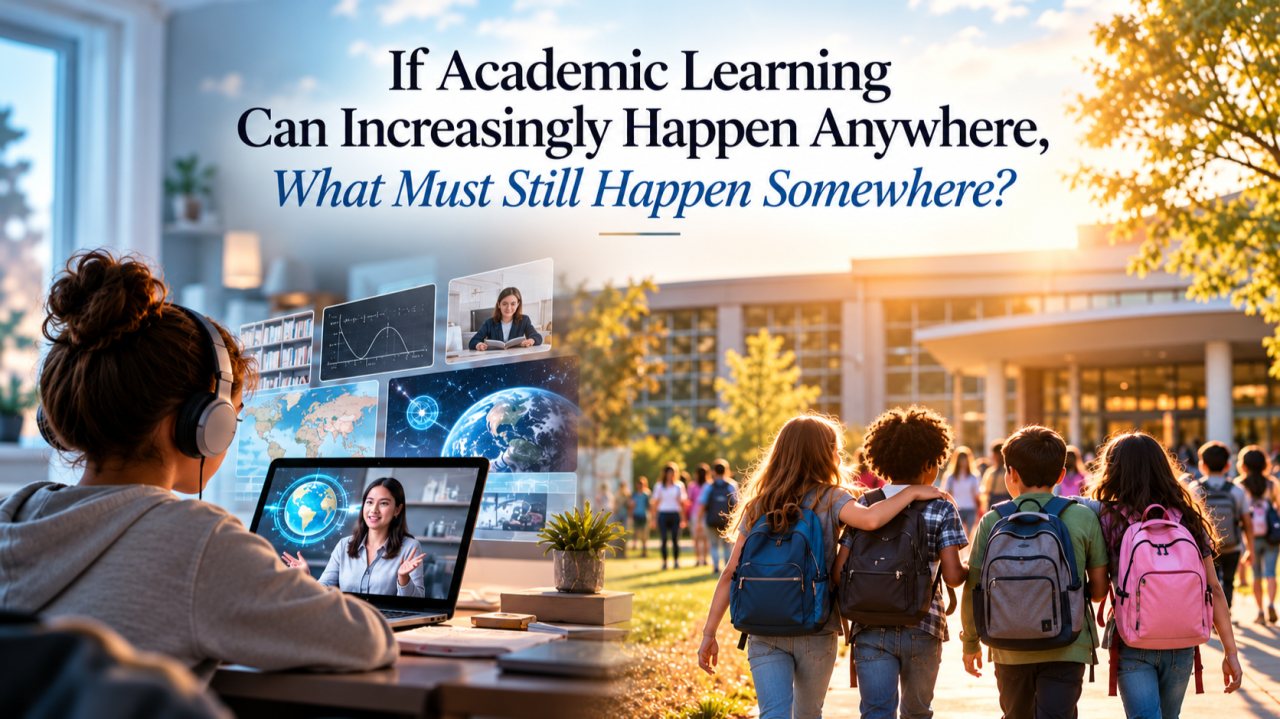
If Academic Learning Can Increasingly Happen Anywhere, What Must Still Happen Somewhere?
The unbundling of education is underway. As AI transforms learning and traditional school models evolve, who becomes responsible for the whole child?

For more than a century, we've largely organized education around a single institution: a school building where children receive academic instruction, develop relationships, access support, and prepare for adult life.
Now several forces are challenging that model simultaneously: AI-powered personalized learning, demographic decline, changing family preferences, budget pressures, and the expansion of learning beyond the traditional classroom.
What we may be witnessing is not simply the evolution of education technology, but the gradual unbundling of education itself.
And that raises a question we have not seriously confronted:
If academic learning can increasingly happen anywhere, what must still happen somewhere?
The classroom is changing. The data tells part of the story.
The National Center for Education Statistics projects a 5% decline in U.S. public school enrollment between fall 2022 and fall 2031, driven primarily by a shrinking school-age population.
In October 2026, Tulsa Public Schools approved the closure or consolidation of 17 school sites, effective in 2027–28. Meanwhile, research from Johns Hopkins found that homeschooling participation increased in 17 of 22 reporting states during the 2025–26 school year, although growth has slowed.
These developments have different causes. Fewer births do not mean every missing student has chosen an alternative school. Budget constraints, shifting populations, and families exploring different educational models cannot be reduced to one explanation.
But together they invite us to reconsider an assumption: that the school building must remain the central location for every dimension of education.
And AI introduces an entirely new variable.
Are we personalizing learning or fragmenting childhood?
Imagine a child who learns mathematics through an AI-supported tutor, explores science in a virtual laboratory, develops coding skills through an online program, and participates in a neighborhood learning hub twice a week.
Academically, that child may have more personalized opportunities than previous generations could have imagined.
But where does that child learn to navigate disagreement? Develop empathy? Form meaningful friendships? Collaborate with people who think differently? Build trust with an adult outside their family?
Where do they experience the daily, sometimes uncomfortable, but essential process of growing up alongside other human beings?
Academic efficiency is not the same as human development.
Research from the CDC associates school connectedness feeling cared for, supported, and valued by peers and adults with stronger attendance, academic outcomes, and student wellbeing.
AI can support the acquisition of knowledge. It cannot replace the lived experience of belonging to a community.
I believe the future of education should never force us to choose between personalized learning and human connection. Technology may transform how children acquire knowledge, but relationships shape how they understand themselves and the world.
As we rethink where learning happens, we cannot lose sight of where children feel they belong.
The next challenge isn't just personalization. It's continuity.
Consider what happens when a child's education becomes distributed across multiple platforms, instructors, programs, and physical spaces.
Who verifies what they have learned? Who understands their progress across those environments? Who notices when engagement begins to decline? And who is responsible for helping when something goes wrong?
Today's education infrastructure is already fragmented. Attendance, academic performance, student support, and learning engagement often live in disconnected systems.
A more distributed model could make that fragmentation even harder to manage.
This is where data provenance becomes essential. Educational records need to be trustworthy, portable, verifiable, and governed by clear permissions. Families should know where information originated, who can access it, and how inaccuracies can be corrected.
But a portable academic record should never become a permanent psychological profile of a child. Better-connected information must strengthen support, not expand surveillance.
The question is not simply who owns the data. It's who remains accountable for the student.
Perhaps the future of school is more human, not less.
Imagine a hybrid system where AI supports personalized academic instruction while schools and community learning hubs provide what technology cannot: trusted relationships, collaborative learning, mentorship, arts, athletics, social development, and a sense of belonging.
Teachers become even more important as mentors, guides, and interpreters of learning not simply distributors of content.
But this future must be equitable. Families cannot be expected to become full-time educators. Transportation, supervision, disability accommodations, meals, and access to technology must remain part of the public responsibility.
Traditional schools will remain essential for many families. Others may choose hybrid or alternative pathways. The goal should not be to replace one model with another, but to preserve what children need across different models.
If education becomes more distributed, the responsibility for supporting children must become more coordinated—not less.
The real frontier of education
For decades, we have measured education primarily through academic achievement, attendance, and graduation rates.
The AI era asks us to think beyond how effectively knowledge is delivered.
Are children becoming more capable of understanding themselves? Building relationships? Navigating uncertainty? Solving problems collaboratively? Feeling connected to a community that cares whether they show up?
We may be approaching a future where academic instruction is increasingly personalized, but childhood risks becoming increasingly fragmented.
That is not an inevitable outcome. It is a design choice.
We can decentralize where children learn. We cannot decentralize our responsibility for their development.
If AI can help children learn anywhere, our greatest challenge may be ensuring that every child still has somewhere and someone to belong.