The Election Changed the Leaders. But Who Will Fix Education's Operating System?
New leadership can change policy. But without better data, AI infrastructure, and measurable outcomes, how much will actually change for students and teachers?

Yesterday, Americans voted for new leadership. But will that translate into better education?
The November 3, 2026 elections shifted control of Congress and brought a major change to Texas, where Gina Hinojosa defeated incumbent Governor Greg Abbott. The balance of power on Texas's State Board of Education remained uncertain as votes continued to be counted Wednesday.
New leadership creates opportunities to revisit education funding, teacher preparation, accountability, and the role of technology.
But here's the question that interests me most:
What happens when we change the people making decisions without changing the systems they use to make them?
Texas doesn't just have a teacher problem. It has a systems challenge.
Texas educates nearly 5.5 million public school students.
According to the Texas Education Agency, teacher attrition reached 12.91% in 2024–25, up from 12.16% the previous year.
In 2025, lawmakers approved an $8.5 billion public education funding package, including investments in teacher salaries, preparation, special education, and school operations.
These investments address important needs.
But how do we know which investments are working?
Which preparation programs produce teachers who remain in classrooms? Which campuses need additional support? How quickly are struggling students receiving help? And which interventions improve outcomes over time?
The data exists across different systems. Connecting it into a reliable picture is another challenge.
More money without measurable outcomes creates uncertainty. More technology without connected data creates complexity.
Neither is a substitute for understanding what actually works.
We've digitized education. Have we modernized its infrastructure?
School districts operate student information systems, learning platforms, assessment tools, staffing databases, financial software, and student-support programs.
Each collects information. But information is not intelligence.
A district might know that attendance is declining, experienced teachers are leaving, and academic performance is deteriorating.
But can it determine how these patterns relate? Can it distinguish correlation from cause? Can it identify which actions improved outcomes?
Too often, educators and administrators must assemble that picture manually.
This is where AI presents a significant opportunity—and a serious responsibility.
AI should help us solve problems, not automate dysfunction.
Imagine an education system where information from authorized sources is connected, updated, and traceable to its origin.
Where leaders can examine historical trends alongside current conditions.
Where AI helps identify emerging patterns, evaluate potential interventions, and reduce repetitive administrative work.
And where every meaningful intervention has a responsible human, a follow-up process, and a measurable outcome.
That requires four foundational capabilities: trustworthy data, contextual analysis, coordinated human action, and continuous evaluation.
Not another collection of disconnected dashboards.
We don't need AI to make education's existing problems move faster. We need better infrastructure to understand and address them.
This is the opportunity Blueprint EQ is pursuing.
At Blueprint EQ, we're developing behavioral intelligence infrastructure designed to connect consented student engagement and wellbeing signals across existing education platforms.
The goal is to help educators recognize meaningful changes earlier, understand the available context, coordinate appropriate human support, and evaluate whether that support helped.
It doesn't replace teachers, counselors, or institutional judgment.
Nor can technology alone resolve inadequate funding, teacher preparation, or staffing shortages.
The promise of this approach must be tested against real outcomes, not simply the number of alerts or insights generated.
The real test of education reform
The November election may influence which policies are prioritized and how education dollars are allocated.
But regardless of which party governs, the fundamental questions remain.
Are teachers receiving the support they need?
Are students becoming more engaged and successful?
Are resources reaching the schools and families that need them?
And can we demonstrate that our decisions made a measurable difference?
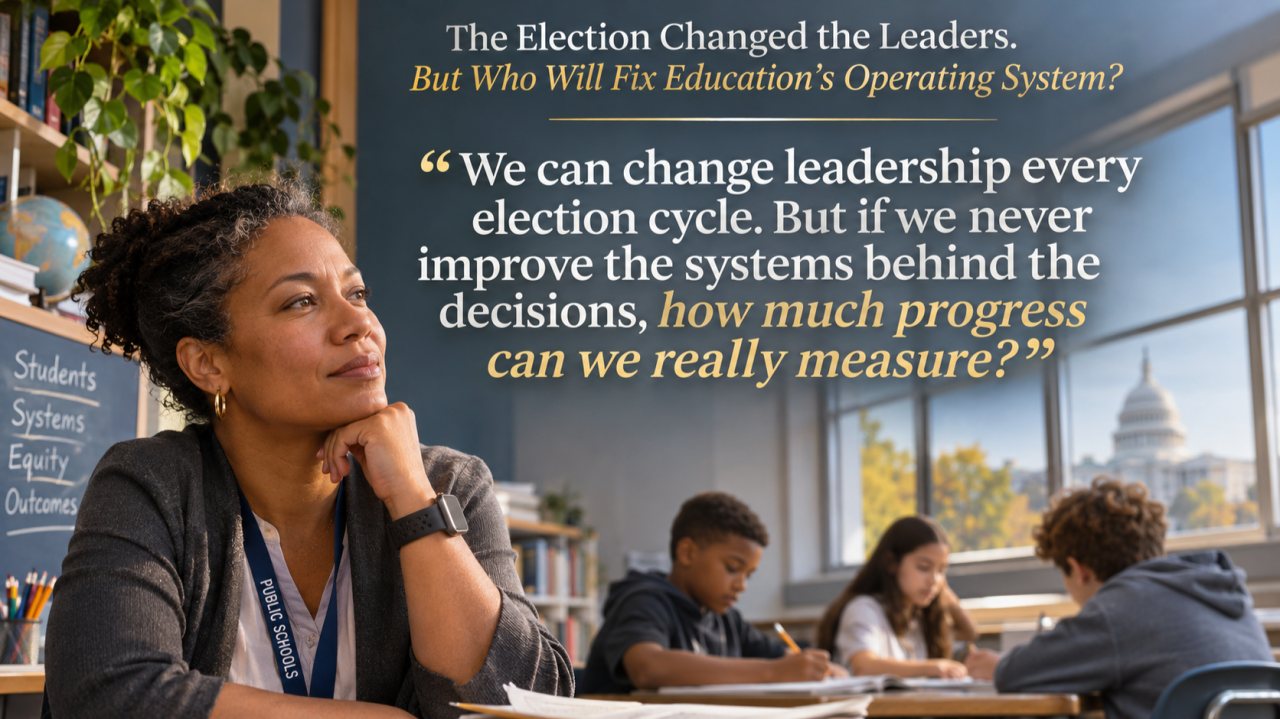
We can change leadership every election cycle. But if we never improve the systems behind the decisions, how much progress can we really measure?
The next chapter of education should not be defined solely by who holds office.
It should be defined by what we can understand, improve, and prove.
Because the goal is not simply a smarter education system.
It's an education system that makes better decisions for the humans it serves.